Best Electric Nail Drill: 40,000 RPM Cordless E-File Kit
Portable 40,000 RPM cordless nail drill with LCD display and 7 bits for at-home gel and acrylic nails. Speed, safety, pros and cons.
 ▶ YouTube
#ad · Heads up: this post contains affiliate links. As an Amazon Associate we earn from qualifying purchases — at no extra cost to you. It funds our own questionable purchases. Full disclosure.
A 30,000–35,000 RPM cordless electric nail drill with a 2,000 mAh battery and 11-piece bit set is the sweet spot for at-home gel removal and cuticle work, balancing power, portability, and price for DIYers who want salon results without the salon bill.
What Is an Electric Nail Drill and Why You Need One
An electric nail drill (e-file) is a handheld rotary tool that spins interchangeable bits at speeds up to 35,000 RPM to file, shape, and remove enhancement product faster and more precisely than hand files. It replaces multiple manual tools, cuts prep time by 50–70%, and enables professional-grade cuticle cleanup, gel polish removal, and acrylic shaping at home. Most consumer models weigh 150–300 grams and run on rechargeable lithium-ion batteries or AC adapters.
If you’ve ever spent 45 minutes picking off chipped gel with a metal pusher, you know the wrist strain is real. An e-file turns that ordeal into a five-minute job. The motor drives a collet (usually 3/32” or 1/8”) that accepts carbide, ceramic, diamond, or mandrel bits. Speed control is typically a dial or buttons adjusting in 1,000–5,000 RPM increments. Forward/reverse switching matters for left-handed users and for bit direction during cuticle work. Quality units maintain torque under load — cheap ones stall when you press a carbide barrel bit into hard builder gel.
How to Choose the Right Electric Nail Drill
Start with your primary use case: natural nail prep, gel polish removal, acrylic/builder gel removal, or full extension work. For natural nails and soft gel, 15,000–20,000 RPM is plenty; hard gel and acrylic demand 25,000–35,000 RPM with sustained torque. Motor type separates toys from tools: brushed DC motors cost less but generate heat and wear after 300–500 hours; brushless motors run cooler, last 2,000+ hours, and keep consistent speed under pressure. Collet size dictates bit compatibility — 3/32” (2.35 mm) is the global standard for professional bits; 1/8” (3.175 mm) limits you to cheaper hobby sets.
Power source shapes your workflow. Corded units deliver unlimited runtime and higher peak power (often 10–15 W) but tether you to an outlet. Cordless models with 1,500–2,500 mAh batteries run 2–5 hours per charge at medium speed; look for USB-C charging and pass-through operation so you can keep filing while plugged in. Handpiece ergonomics affect fatigue: aluminum bodies dissipate heat better than plastic, and a tapered grip (22–28 mm diameter) reduces cramping during 30-minute sessions. Noise floor matters in shared spaces — quality brushless units hover at 45–55 dB at max speed; budget brushed units hit 65–75 dB.
Corded vs Cordless: Which Fits Your Routine
Corded drills provide consistent 10–15 W output with zero battery anxiety, making them ideal for back-to-back client work or marathon DIY sessions. Cordless drills trade peak power (typically 5–8 W) for mobility; a 2,000 mAh cell delivers roughly 3 hours at 15,000 RPM or 90 minutes at 30,000 RPM. Pass-through charging lets you finish a set while plugged in, but the cable still restricts movement. If your manicure station is a kitchen table, cordless wins; if it’s a dedicated desk with an outlet strip, corded saves $20–40 upfront.
| Feature | Corded | Cordless (2,000 mAh) |
|---|---|---|
| Max continuous power | 10–15 W | 5–8 W |
| Runtime at 20k RPM | Unlimited | ~2.5 hours |
| Weight (handpiece only) | 180–220 g | 150–190 g |
| Heat buildup after 30 min | Low (vented chassis) | Moderate (battery warms) |
| Portability | Outlet dependent | Purse/bag friendly |
| Typical price range (USD) | $35–70 | $45–90 |
Fact: Brushless cordless models from 2024 onward commonly hit 35,000 RPM no-load while drawing under 6 W, thanks to 3-phase motor controllers and 18650/21700 cells. Brushed equivalents max out around 25,000 RPM at similar wattage.
RPM Ranges Explained: Low, Medium, High
Low (0–15,000 RPM): Safe for natural nail surface prep, cuticle exfoliation with diamond bits, and buffing shine. High torque at low speed prevents bit skipping. Medium (15,000–25,000 RPM): The daily driver zone — removes color gel in 2–3 minutes per nail, shapes tips, refines sidewalls. Most 11-piece bit sets are optimized here. High (25,000–35,000 RPM): Required for bulk acrylic removal, builder gel debulking, and carbide bit efficiency. Sustained high RPM generates heat; use light pressure and intermittent contact (2 seconds on, 1 second off) to avoid burning the nail plate.
Variable speed dials with 1,000 RPM steps beat 3-speed presets because you can match RPM to bit diameter: a 3 mm carbide barrel at 30,000 RPM has a surface speed of ~4.7 m/s, while a 6 mm mandrel at the same RPM hits ~9.4 m/s — too aggressive for thin natural nails. Pro tip: Start every new bit at 5,000 RPM, then ramp up until the bit cuts cleanly without vibration.
Essential Drill Bits and Sanding Bands
A functional starter kit includes: Carbide barrel bit (3/32”, medium grit) for bulk gel/acrylic removal; Carbide cone bit (fine grit) for cuticle area and sidewall refinement; Ceramic barrel bit (medium) — runs cooler than carbide, ideal for sensitive clients; Diamond flame bit (fine) for cuticle exfoliation and pterygium removal; Mandrel + 5–10 sanding bands (80/180 grit) for shaping free edge and prepping tips; Felt or cotton buffing wheel with polishing paste for high-gloss finish. Specialty bits — under-nail cleaner, tapered carbide, safety carbide (rounded tip) — come later.
Bit shank quality determines runout. Precision-ground 3/32” shanks hold ≤0.02 mm runout; stamped hobby bits hit 0.05–0.1 mm, causing vibration that transfers to your hand and damages the nail plate. Carbide bits last 20–40 full sets before dulling; ceramic lasts 30–50; diamond coating wears after 15–25 sets. Sanding bands are single-use per client in salons; at home, replace when grit clogs or tears (every 3–5 manicures).
Battery Life and Charging Realities
Marketing claims “5 hours runtime” usually mean idle speed (5,000 RPM) with no load. Real-world gel removal at 25,000 RPM draws 3–4 A from a 2,000 mAh pack, yielding 35–45 minutes of active filing per charge. Pass-through charging (simultaneous use and charge) is essential — without it, a dead battery halts your session. USB-C PD (Power Delivery) at 5 V/2 A or 9 V/1.5 A recharges a 2,000 mAh cell in 70–90 minutes; micro-USB takes 2.5+ hours. Some 2025–2026 models add a tiny OLED showing remaining mAh, not just 4-bar LED — far more useful for planning.
Battery chemistry matters: Li-ion 18650 cells (common in $50–80 units) degrade to 80% capacity after 300–500 cycles. Li-pol 21700 cells (in $90+ units) hold 80% after 800+ cycles and tolerate deeper discharges. If you file 3×/week, a 21700-powered drill lasts 5+ years; an 18650 unit needs a battery swap (or new drill) around year 2. Non-user-replaceable batteries are the norm — plan accordingly.
Noise, Vibration, and Ergonomics
Brushless motors at 30,000 RPM produce 48–55 dB(A) at 30 cm — comparable to a quiet refrigerator. Brushed motors hit 62–70 dB(A), similar to a conversation. Vibration is the silent fatigue factor: quality handpieces isolate the motor from the grip via rubber dampers, keeping hand-transmitted vibration under 2.5 m/s² (ISO 5349 threshold for 8-hour exposure). Cheap units transmit 4–6 m/s², causing tingling after 15 minutes. Weight distribution shifts with bit length: a 45 mm carbide bit adds 12–15 g to the nose, moving the center of gravity forward. Balanced designs place the battery low in the handle to counter this.
Grip texture prevents slip when hands get oily from cuticle oil. Knurled aluminum > matte plastic > glossy plastic. Some 2026 models add a subtle flat facet on the grip so the drill won’t roll off a tilted table — a small touch that saves cracked handpieces.
Safety Features That Matter
Auto-stop overload protection cuts power if current exceeds 4–5 A (stall condition), saving the motor and preventing bit grab injuries. Soft-start ramp (0.5–1 second to target RPM) prevents the bit from catching on a thick gel edge at full speed. Forward/reverse lockout requires a deliberate 2-second hold to switch direction, avoiding accidental reversal mid-cuticle-work. Thermal shutdown at 65–70 °C internal temperature protects lithium cells. Collet lock (spindle lock button) allows one-handed bit changes — without it, you need two wrenches or a risky “hold the bit with pliers” maneuver.
Eye protection is non-negotiable: carbide bits can shatter at 35,000 RPM, launching fragments at 100+ m/s. ANSI Z87.1 safety glasses cost $3. Dust extraction — even a $15 USB nail dust collector pulls 80% of fine particulate; without it, you inhale methacrylate dust and acrylic powder. A 2023 study measured 0.3 mg/m³ PM2.5 during a 20-minute gel removal with extraction vs 2.1 mg/m³ without — seven times higher.
Common Mistakes and How to Avoid Them
- Running carbide bits backward — flutes are directional; reverse dulls them instantly and creates heat. 2. Pressing hard — let the RPM do the work; pressure >200 g flexes the nail plate, causing onycholysis. 3. Skipping grit progression — jumping from 80-grit band to 180-grit leaves deep scratches that weaken enhancements. 4. Filing natural nails at >15,000 RPM — thins the plate, invites splitting. 5. Ignoring bit runout — a wobbling bit cuts uneven trenches; check by spinning at 5,000 RPM and watching the tip. 6. Charging overnight on a flammable surface — lithium fires are rare but real; charge on a ceramic tile or metal tray. 7. Using acetone to clean bits — dissolves carbide binder and ceramic adhesive; use 99% isopropyl alcohol and a brass brush.
Maintenance and Longevity
Daily: Brush hair/dust from vents with a soft paintbrush. Wipe handpiece with 70% IPA. Weekly: Remove collet, clean threads with brass brush, apply one drop of synthetic sewing machine oil (not WD-40) to the collet threads. Monthly: Check bit shanks for corrosion; discard any with pitting. Every 6 months: If cordless, run a full discharge/charge cycle to recalibrate the fuel gauge. Collet replacement every 12–18 months (or when bits seat loosely) — a $5 part prevents $50 handpiece damage. Motor brushes (brushed units only) last 300–500 hours; replace when speed becomes erratic under load.
Storage: Keep bits in a magnetic tray or labeled case — loose bits in a drawer chip each other’s cutting edges. Store the drill upright on its stand; laying it on its side stresses the collet bearing. Temperature range: 10–35 °C for operation, 0–45 °C for storage. Avoid bathrooms — humidity corrodes motor bearings and battery contacts.
FAQ
What RPM do I need to remove builder gel? Builder gel requires 25,000–30,000 RPM with a medium-grit carbide or ceramic barrel bit. Lower RPM stalls; higher RPM risks heat spikes. Use light pressure and a dust collector.
Can I use an electric nail drill on natural nails? Yes, but stay under 15,000 RPM. Use a fine diamond flame bit for cuticle work and a 180-grit sanding band for gentle shaping. Never use carbide on natural nail plates.
How long does a cordless nail drill battery last per charge? A 2,000 mAh battery delivers 35–45 minutes of continuous gel removal at 25,000 RPM, or 2–3 hours of intermittent prep work at 10,000–15,000 RPM.
Are expensive nail drill bits worth it? Precision-ground carbide/ceramic bits (0.02 mm runout) last 2–3× longer, vibrate less, and cut cleaner than stamped hobby bits. The $15–25 per bit pays off in nail health and time.
Do I need a dust collector with an electric nail drill? Yes. Fine acrylic and gel dust stays airborne for hours. A $15–30 USB collector captures 80%+ of PM2.5, protecting your lungs and keeping your workspace clean.
Can I change bits without a spindle lock? Technically yes — hold the chuck with one hand and twist the bit with the other — but it’s awkward and risks dropping bits. A spindle lock button enables true one-handed changes in 3 seconds.
The picks
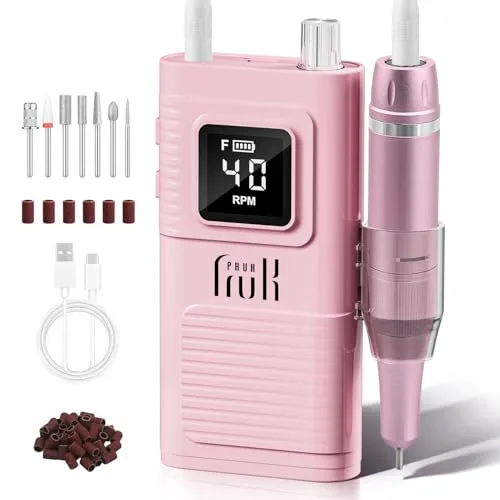
Professional Electric Nail Drill Kit, Portable 40000RPM Cordless E-File with LCD Display, 7 Drill Bits & 56 Sanding Bands, Manicure Nail Machine for Salon Home, Training & Travel, Pink
This 40000RPM cordless nail drill delivers pro-level shaping in a hot pink shell that screams 'I'm fancy but I still clip my coupons.'
- Ultra-high 40000RPM speed
- Cordless portable design
- Includes 7 drill bits
- LCD display control
#ad · As an Amazon Associate we earn from qualifying purchases.
Explore more Self-Care finds →
Questions you were too broke to ask
What RPM should a good electric nail drill have? +
For salon-quality results at home, look for an electric nail drill that reaches at least 30,000RPM, with 40,000RPM being ideal for fast, smooth shaping.
Is a cordless nail drill worth it? +
Yes — a cordless electric nail drill offers the freedom to move around, travel easily, and work without being tethered to an outlet, making at-home manicures much more convenient.
Can beginners use a 40000RPM nail drill? +
Beginners can use a 40000RPM nail drill safely by starting at a low speed and gradually increasing it as they gain control, ensuring gentle, precise results.
What accessories come with a nail drill kit? +
A complete electric nail drill kit typically includes multiple drill bits for shaping, buffing, and cuticle care, along with assorted sanding bands for a smooth finish.

Jonathan Moreno · Founder & Curator
Jonathan Moreno is the founder and curator behind Broke But Fancy. Part deal-hunter, part aesthetics addict, he vets every find so your space looks expensive while your bank account quietly recovers. Champagne taste, tap-water budget — professionally.
Meet the curator