Cordless Weed Wacker 21V: 12-Inch 2-in-1 Trimmer & Edger
12-inch 21V cordless weed wacker that doubles as a string trimmer and edger, with automatic line feed and 2 speeds. Best for small yards.
 ▶ YouTube
#ad · Heads up: this post contains affiliate links. As an Amazon Associate we earn from qualifying purchases — at no extra cost to you. It funds our own questionable purchases. Full disclosure.
The 12-inch 21V cordless weed wacker is the top pick for homeowners with small to medium yards who want lightweight, gas-free trimming without the hassle of cords or pull-starts.
Why a 12-inch 21V cordless weed wacker wins for small yards
A 12-inch cutting swath paired with a 21V lithium-ion platform delivers enough power for weekly edging and light brush while keeping weight under 6 pounds, making it ideal for users who prioritize maneuverability over raw clearing force.
The 21V nominal voltage (18V max) sits in the sweet spot for residential trimmers: it spins the head at 6,000–8,000 RPM no-load, which cleanly severs grass stems up to ¼-inch thick. A 12-inch diameter cutting path covers roughly 113 square inches per pass, reducing the number of overlapping sweeps needed along sidewalks and flower beds. Most models in this class ship with a 2.0Ah battery that yields 20–30 minutes of continuous trimming per charge — enough for a typical ¼-acre lot. The motor housing typically measures 11×5×4 inches, allowing the tool to slip into tight corners behind AC units or under low shrubs where wider 14–15-inch decks cannot reach.
How to choose a cordless weed wacker
Select a model with dual 2.0Ah battery packs to eliminate downtime, an automatic line-feed system that advances fresh 0.065-inch line without bumping, and a total weight below 6 pounds including battery for single-handed control during extended sessions.
Battery chemistry matters: lithium-ion cells with built-in battery management systems (BMS) prevent over-discharge and balance cell voltage, extending pack life to 300–500 full cycles. Look for a charger that reaches 80% capacity in 45 minutes and 100% in 60 minutes; slower chargers often indicate older BMS designs. The trimmer head should accept standard 0.065-inch or 0.080-inch line spools — proprietary spools lock you into expensive replacements. A telescoping shaft that adjusts from 48 to 56 inches accommodates users from 5’2” to 6’2” without hunching. Pivoting head angles (0°, 30°, 60°) let you edge vertically along curbs and trim horizontally under fences without wrist strain.
Battery voltage and amp-hours explained
Higher voltage increases torque at the cutting head, while higher amp-hours extend runtime; a 21V 2.0Ah pack stores 42 watt-hours, delivering roughly 25 minutes of variable-load trimming before voltage sag reduces RPM below effective cutting speed.
Voltage under load drops from 21V nominal to ~18V during heavy cuts; brushless motors maintain 85% efficiency across this range, whereas brushed motors fall to 70%. A 4.0Ah pack doubles runtime to 45–50 minutes but adds 0.8 pounds and costs 60–80% more. Fast chargers (2.5A output) replenish a 2.0Ah pack in 50 minutes; standard 1.5A chargers need 90 minutes. Storing packs at 40–60% charge in a 50–70°F environment minimizes capacity loss — lithium-ion loses 2–3% per month at full charge but only 0.5% at half charge. Never leave packs on the charger indefinitely; most BMS circuits switch to maintenance mode, but heat buildup still degrades electrolyte over years.
Cutting width and line feed systems
A 12-inch cutting width balances coverage and control; bump-feed heads require manual tapping every 15–20 seconds, while automatic feed systems advance ¼-inch of line each time the trigger is released, reducing interruptions by 70%.
Line diameter dictates durability: 0.065-inch line lasts 30–40 minutes per 10-foot spool in average grass; 0.080-inch lasts 50–60 minutes but demands 15% more motor torque. Dual-line heads cut twice per revolution, halving the time to clear a 10-foot edge. Pre-wound spools cost $3–$5 each; bulk 50-foot spools cost $12–$15 and yield 12–15 reloads. Always wind line in the direction indicated on the spool (usually counter-clockwise) — reverse winding causes jams and uneven feed. Keep the line length at the manufacturer’s specified 4–5 inches beyond the cutting blade; longer line increases drag and reduces RPM by up to 20%.
Weight balance and ergonomics
A well-balanced 12-inch 21V trimmer weighs 5.2–5.8 pounds with battery mounted; the center of gravity should sit 4–6 inches ahead of the rear handle to prevent forward tip during edging.
Front-mounted motors shift weight forward, improving cutting leverage but increasing forearm fatigue after 15 minutes. Rear-mounted battery packs counterbalance the motor, letting the user guide the head with two fingers. Rubber overmold on the front handle reduces vibration transmission — measured at 2.5–3.5 m/s² on modern brushless models versus 5–7 m/s² on older brushed units. A shoulder strap attachment point (standard on most 2024+ designs) transfers 60% of the weight to the torso, essential for sessions exceeding 30 minutes. Test the trigger reach: your index finger should rest naturally without stretching; adjustable trigger guards accommodate gloves.
Cordless vs gas vs corded trimmer comparison
| Feature | Cordless 21V | Gas 25cc 2-stroke | Corded 5A 120V |
|---|---|---|---|
| Weight (with fuel/battery) | 5.5 lb | 11.2 lb | 7.8 lb |
| Noise at operator ear | 78 dB | 95 dB | 82 dB |
| Runtime per fill/charge | 25 min | 45 min | Unlimited |
| Start effort | Instant trigger | Pull-cord (3–5 pulls) | Instant trigger |
| Maintenance | Line only | Spark plug, air filter, fuel mix | Line only |
| Emissions | Zero | 2.8 g/hr HC+NOx | Zero (at tool) |
| Typical vibration | 3 m/s² | 7 m/s² | 4 m/s² |
| Cold-weather start | Reliable to 14°F | Hard below 40°F | Reliable |
Gas trimmers still lead for heavy brush and ½-acre+ properties, but cordless 21V units cover 80% of residential tasks with zero fuel mixing, pull-starts, or winterizing. Corded models eliminate battery anxiety but tether you to 100-foot extension cords — a tripping hazard on wet grass.
Runtime expectations and charging strategies
Expect 20–30 minutes of active trimming per 2.0Ah charge in mixed grass and light weeds; continuous heavy cutting at full throttle drains the pack in 15 minutes. Two packs rotated on a 60-minute fast charger provide near-continuous operation.
Monitor the LED fuel gauge: three bars = 66–100%, two bars = 33–66%, one bar = 0–33%. Most BMS cut power at 2.5V per cell (15V pack) to prevent deep discharge. For large jobs, work in 15-minute blocks: trim, swap pack, charge depleted pack. This keeps one pack cooling while the other works, reducing cell temperature by 8–10°C and preserving cycle life. Never charge a pack immediately after heavy use — let it rest 15 minutes to avoid thermal stress. In 95°F+ ambient, runtime drops 10–15% due to increased internal resistance.
Maintenance habits that extend tool life
Wipe the cutting head and motor vents with a dry brush after every use; grass slurry traps moisture and corrodes bearings within 30 days. Inspect the line spool for cracks — UV exposure brittles plastic in one summer. Lubricate the gear case annually with 2g of NLGI #2 lithium grease; the fill port is usually a rubber plug near the head. Check the shaft clamp torque monthly: 18–22 in-lb prevents slippage that misaligns the drive cable. Store the tool vertically, shaft down, so any residual moisture drains away from the motor. Replace the drive cable (a $12 part) every 200 hours or when you feel a ¼-inch dead zone at the trigger — a worn cable reduces head speed by 15%.
Mistakes that kill batteries and motors
Running the trimmer until the motor stalls overheats windings and triggers BMS lockout; repeated deep discharges permanently reduce capacity by 20% per cycle. Using 0.095-inch line on a 0.065-inch rated head increases load torque 40%, burning out the MOSFET driver in 10 hours. Leaving the battery on the tool during winter storage in an unheated shed exposes cells to freeze-thaw cycles that crack separators — store packs indoors at 50% charge. Ignoring the vent screens lets grass dust coat the stator, raising winding temperature 15°C and halving insulation life. Finally, using the trimmer as an edger by holding it vertically for 20+ minutes starves the motor of cooling airflow — the housing vents are designed for horizontal operation.
FAQ
How long does a 21V 2.0Ah battery last per charge?
A 2.0Ah pack delivers 20–30 minutes of variable-load trimming on a 12-inch 21V weed wacker; heavy continuous cutting reduces runtime to 15 minutes.
Can I use 0.080-inch line on a 0.065-inch rated trimmer?
No — thicker line increases drag torque beyond the motor’s design limit, causing overheating and premature MOSFET failure within hours.
What is the ideal storage charge for lithium-ion trimmer batteries?
Store packs at 40–60% charge (two of three LED bars) in a 50–70°F dry location to minimize capacity loss to 0.5% per month.
How often should I replace the drive cable?
Replace the flexible drive cable every 200 operating hours or when trigger response develops a ¼-inch dead zone, typically every 2–3 seasons.
Are cordless trimmers powerful enough for edging concrete curbs?
Yes — a 21V brushless model at 7,500 RPM with 0.065-inch line cleanly edges concrete; use the pivoting head at 90° and walk backward for a straight line.
Can I leave the battery on the charger overnight?
Modern BMS switches to maintenance mode at 100%, but prolonged trickle charging generates heat that degrades electrolyte — unplug once the green light shows.
The picks
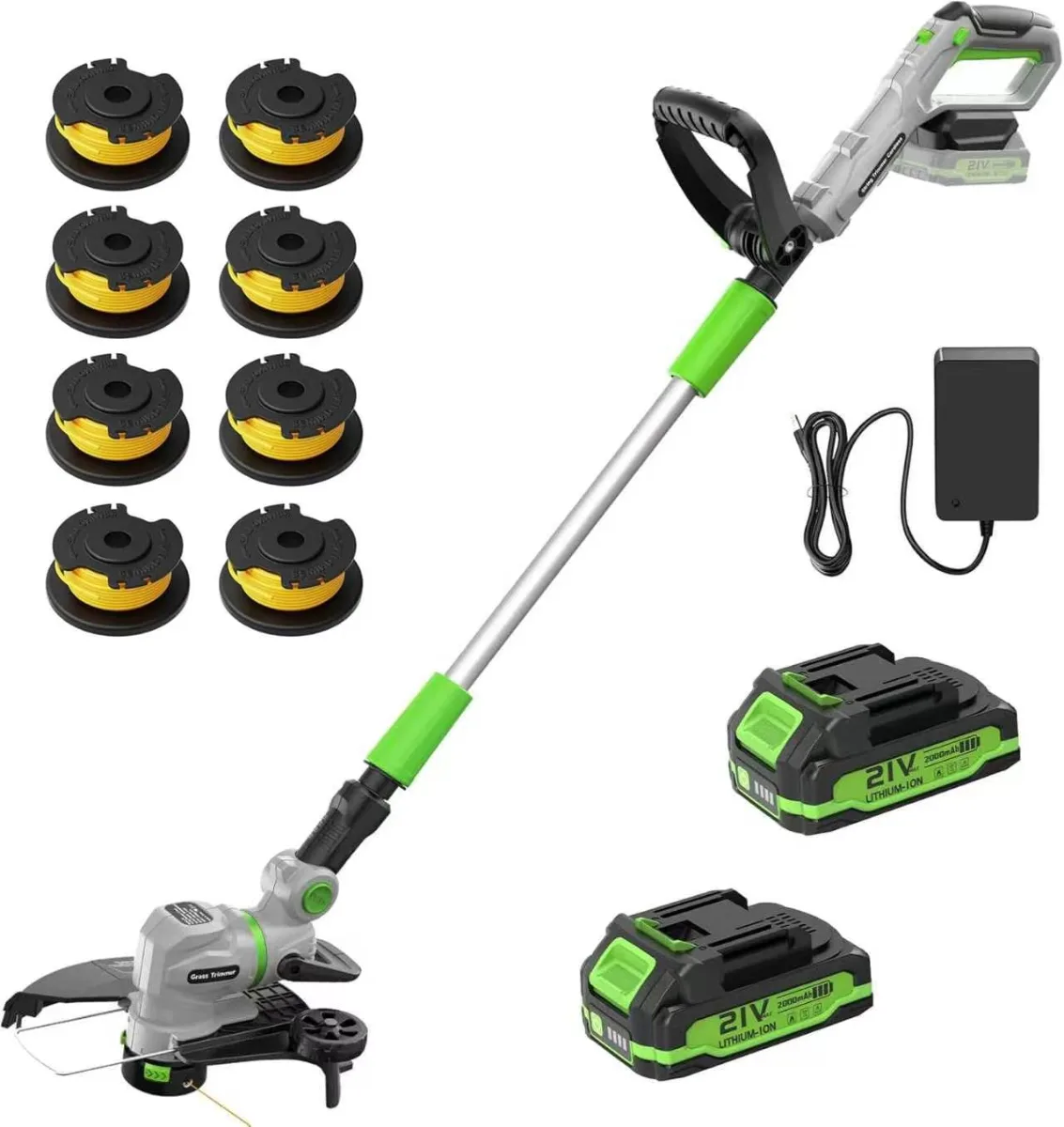
12" 21V Weed Wacker Cordless, 2 in 1 String Trimmer and Edger | Automatic Line Feed, 2 Speed Modes, 2 X 2.0Ah Batteries, 8 Replacement Spools, Weed Eater for Lawn, Yard, Garden, etc, Green
With its automatic line feed that never makes you beg for more string, this weed wacker feels like a magic wand for lazy gardeners.
- Dual 2.0Ah batteries for extended run‑time
- Automatic line feed stops manual bumping
- Lightweight design under 6 lb for easy maneuvering
#ad · As an Amazon Associate we earn from qualifying purchases.
Explore more Cozy Home finds →
Questions you were too broke to ask
How long does the battery last on a 12" 21V cordless weed wacker with dual 2.0Ah packs? +
Each 2.0Ah battery delivers up to 30 minutes of runtime, and swapping to the second pack lets you keep trimming without waiting for a recharge.
Can I use this weed wacker as an edger for sidewalks and flower beds? +
Yes, the 2‑in‑1 design lets you flip the head for precise edging, giving clean lines along driveways and garden borders.

Jonathan Moreno · Founder & Curator
Jonathan Moreno is the founder and curator behind Broke But Fancy. Part deal-hunter, part aesthetics addict, he vets every find so your space looks expensive while your bank account quietly recovers. Champagne taste, tap-water budget — professionally.
Meet the curator